Minor Arcana, Wands
Ten of Wands
burden, overload, duty, strain
Upright
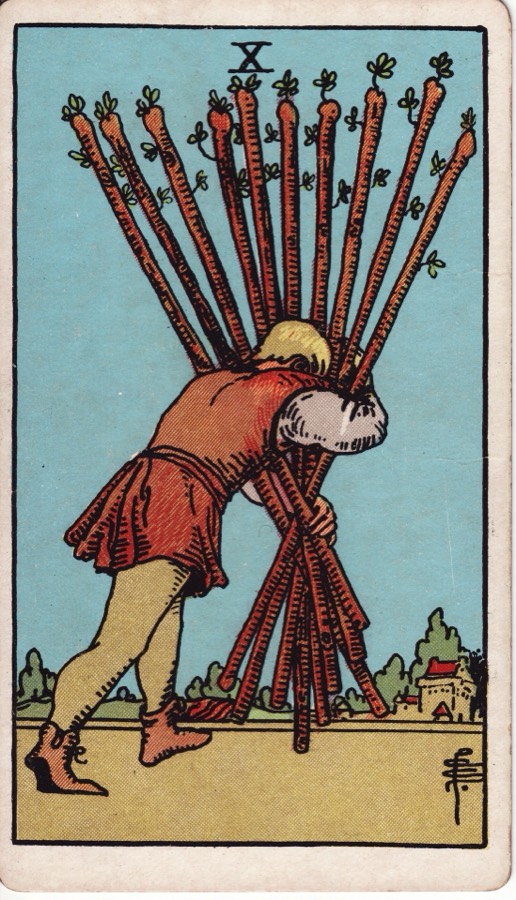
A figure bent double carries ten staves toward a distant town, face hidden by the bundle. Waite's chief word is oppression, including the burden that success itself can bring.
The promotion that doubled your workload or the family role nobody else takes up could fit here. List what you carry and mark what truly needs you. Hand over one item this week. Waite's line about losing a lawsuit is no forecast; a lawyer can advise on a real case.
Reversed
Waite gives only contrarieties, difficulties and intrigues here. The load may have started to slip, or people around you may be working at cross purposes and adding weight without saying so.
Before taking on anything else, find out who expects what from you. An honest talk with a manager or partner can expose duties that clash. Dropping one on purpose usually beats dropping several by accident.
A card is a prompt for reflection. It cannot promise a result, and it is no substitute for medical, legal or financial advice.
In Waite's words
Upright: A card of many significances, and some of the readings cannot be harmonized. I set aside that which connects it with honour and good faith. The chief meaning is oppression simply, but it is also fortune, gain, any kind of success, and then it is the oppression of these things. It is also a card of false-seeming, disguise, perfidy. The place which the figure is approaching may suffer from the rods that he carries. Success is stultified if the Nine of Swords follows, and if it is a question of a lawsuit, there will be certain loss.
Reversed: Contrarieties, difficulties, intrigues, and their analogies.
From A. E. Waite, The Pictorial Key to the Tarot (1910), Part 3, on Wikisource. The meanings above are by Cast & Chart.
Card art by Pamela Colman Smith, 1909, public domain, via Wikimedia Commons.