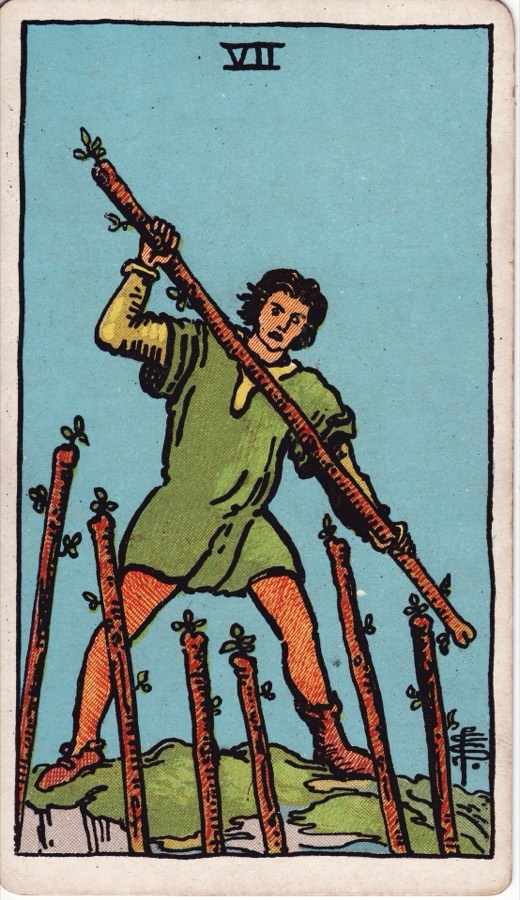
Minor Arcana, Wands
Seven of Wands
courage, defence, negotiation, advantage
Upright
One figure stands on high ground, staff raised against six coming up from below. Waite calls this valour, and also argument, negotiation and trade rivalry. The person on top is outnumbered and holds the better position.
Facing pushback over a decision at work or in the family, decide which point really matters and hold that one. Prepare your reasons and answer objections one by one. Your footing may be stronger than the number of critics suggests.
Reversed
Reversed, the defender loses footing. Waite names perplexity, embarrassment and anxiety, and warns against indecision in particular.
Trying to answer every critic at once tends to leave you tired and unclear. Pick a position on the question in front of you, even a provisional one, and say when you will review it. A stated choice is easier to defend or change than a vague one.
A card is a prompt for reflection. It cannot promise a result, and it is no substitute for medical, legal or financial advice.
In Waite's words
Upright: It is a card of valour, for, on the surface, six are attacking one, who has, however, the vantage position. On the intellectual plane, it signifies discussion, wordy strife; in business—negotiations, war of trade, barter, competition. It is further a card of success, for the combatant is on the top and his enemies may be unable to reach him.
Reversed: Perplexity, embarrassments, anxiety. It is also a caution against indecision.
From A. E. Waite, The Pictorial Key to the Tarot (1910), Part 3, on Wikisource. The meanings above are by Cast & Chart.
Card art by Pamela Colman Smith, 1909, public domain, via Wikimedia Commons.